
There’s something a little bewitching about meeting the real life versions of the fictional heroes you create inside your imagination.
Back in the 1990s, I was fresh out of high school and newly married and living on the other side of the country near a military base, working while my husband was deployed for weeks or months at a time. I’m not a particularly social creature, so most evenings and weekends were spent in a library or pouring over books at my apartment, writing copious notes down in a spiral notebook, fleshing out story ideas. One of my favorite characters, Mr. D., had a law-enforcement-related story set in the familiar (to me) Las Vegas. His story (like so many others) got derailed by a decade of college. When life settled back into a career, I picked up his story and dusted it off, and found that his character had grown by leaps and bounds in the not-so-dormant corners of my imagination.
By sheer coincidence, D’s backstory made him the perfect minor character to be in France to help his cousin a few years earlier for a completely different story. In considering who I needed D to be for both stories, I discovered and researched the Gendarmerie Nationale, (GN) the Groupe d’Intervention de la Gendarmerie Nationale (GIGN), and the Office Centrale de lutte contre le trafic des biens culturels (OCBC). It was all very fascinating (and stretched my French reading comprehension a little—not everything available on the internet can be tackled by Google translate, including treasures like PDFs of old documents.) On paper, D had a pretty solid backstory that I had way too much fun (and probably spent way too much time) exploring for authenticity. I figured I probably wouldn’t use most of what I learned, but at least I knew the details that made him the complex character I needed him to be for his primary story.
Three or four years later, I actually had the opportunity to go to France with my sister-in-law, my niece, and her dance troupe.
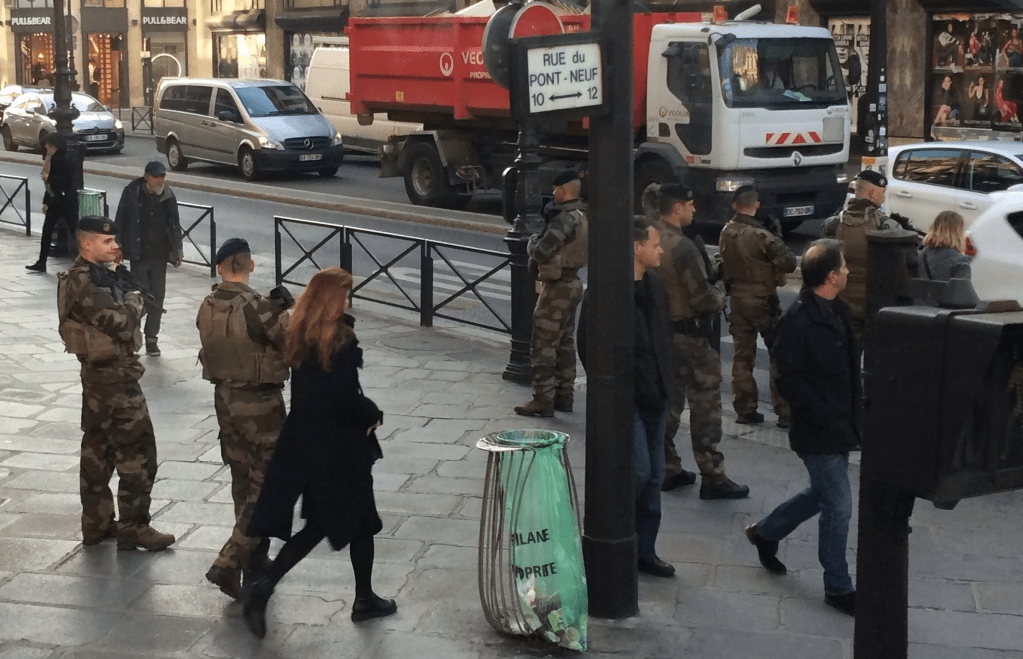
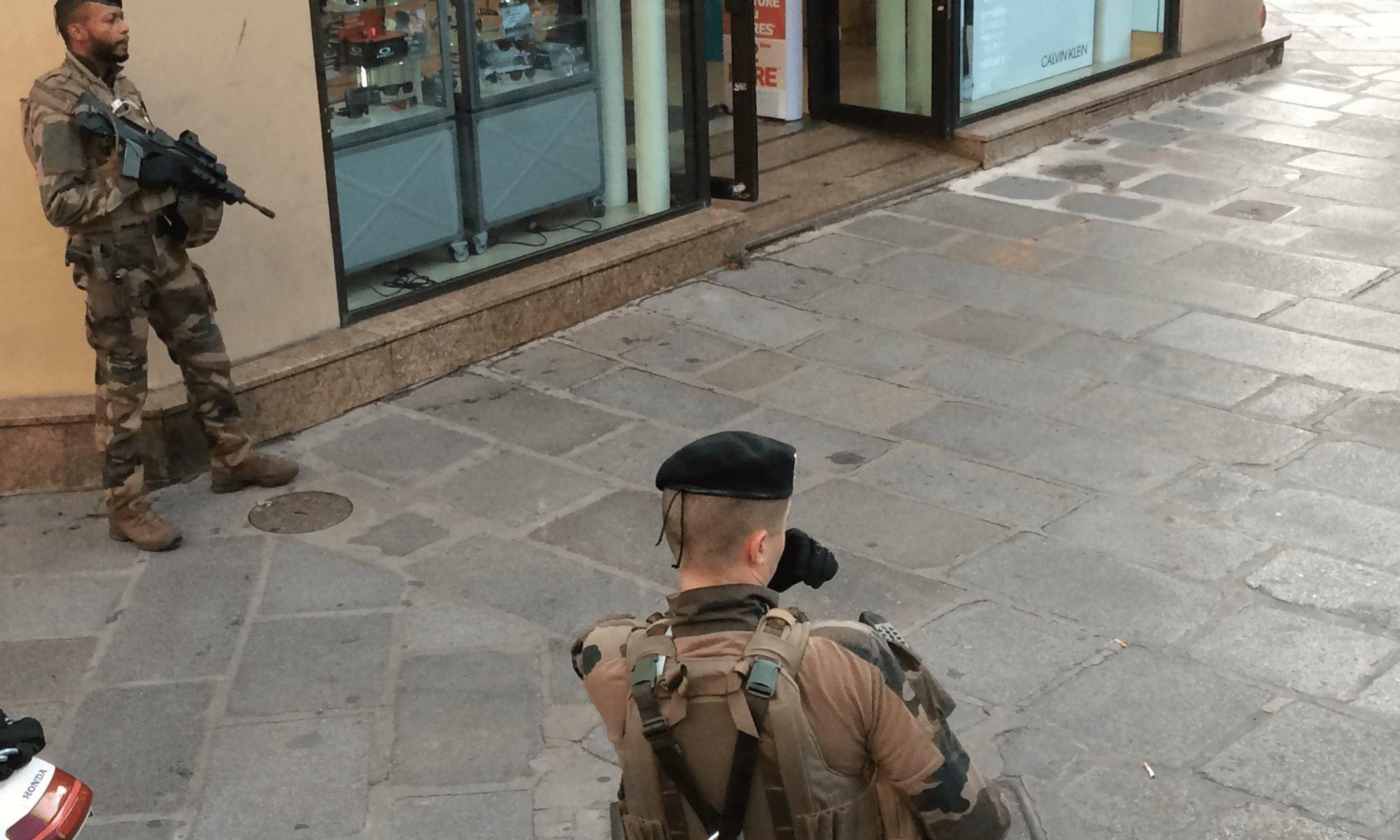
When we arrived, every airport, train station, tourist destination, or busy square had a contingent of men (and occasionally, to my surprise, a woman) dressed in camouflage fatigues/battle dress uniforms, berets on their heads, and rifles—possibly Fusil d’Assaut de la Manufacture d’Armes de Saint-Étienne (FAMAS) or their replacements, HK416F….not that I would recognize either one on sight—slung across their shoulders and always held in a position ready to shoot if needed. Each group had 3-9 people (most often 4-5 men), and one of their group usually carried slightly different equipment on his back, as though he was the medic or the radioman. Each group’s berets varied in shape and style and color, so that the berets they wore marked them as a distinct group even if the way they moved together didn’t already make that obvious.
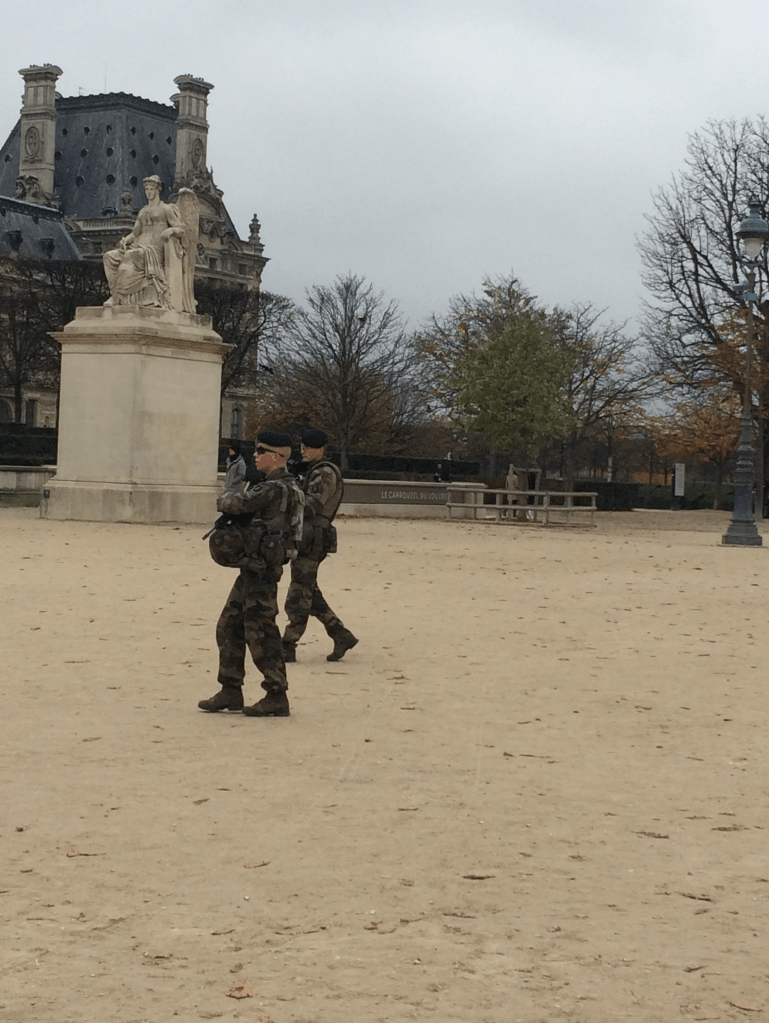
At the Louvre, they wandered the courtyard up on the surface, and inside the museum and shopping area underground. They walked the grounds of the Versaille Palace. They roamed the streets near our Paris hotel. One group in Lyon had berets that hung down so far over their left eyes, it was a wonder they could see anything at all on that side. In Marseille, as I was getting my bearings on my smart phone map to leave the train station and walk downhill to the Old Port, I almost ran into a group of them walking perpendicular to me. Startled, I stopped just short of them, appalled that I’d almost walked right into the middle of them, and the baby-faced soldier in front made eye contact and tried to hold back a grin. The rest of them—in Marseille and everywhere else I went—always had serious expressions on their faces and they clearly weren’t there to chat or make friends with anyone. They were alert and always on the move, but never in a hurry, and always moving together as a group within arm’s reach of each other.
One night in Paris we sat down as a large group of about 20 to eat dinner at an elegant buffet-style restaurant. Just as we sat down, a group of nine of these large, heavily armed men came in and sat down on the other side of a decorative wooden partition. The partition offered sufficient rectangular cutouts for me to watch them surreptitiously as they removed their body armor and rifles and took turns getting their food from the buffet downstairs. My sister-in-law got a kick out of watching my face light up every time I saw them in Paris, like a little kid in a candy store. I think she kept teasing me because she assumed I had a crush on them or something, but the truth was, here were the men I had researched on paper! Men who lived and breathed the kind of life that I wanted to capture in words to describe my character…somehow both larger-than-life and completely ordinary.
As they ate their dinner and joked back and forth in French, they reminded me of the brotherhood I’ve seen between firemen, and sometimes between policemen, and read about from military units and motorcycle clubs. Familiarity. Trust. Reliance. Professionalism. Structure. An almost tangible connection that marks them as a group apart. One of the men was older than the others, and he seemed to be in charge in a subtle way. Not that anyone looked to him for orders or permission—they all seemed to carry themselves with complete confidence, situational awareness, and personal responsibility—but he carried himself with an added layer of responsibility for the men, the equipment, the security of the environment. There was a tone in his voice on the rare occasions he spoke that sounded weathered and more patient, and full of wisdom, experience, or instruction. As we boarded the coach outside the restaurant I overheard some complaints from others about the food, but I don’t even know what we ate. I was too busy quietly absorbing details about heroes who spoke a language I barely understood.

Heroes…? I don’t know anything about them or how honorably they live their lives. But (based on what I’ve read) they train hard to serve and protect their country, to maintain public safety and order, and they’re willing to put their lives on the line at a time when terrorists are running amok. Something about that feels rather heroic to me. The GIGN had a motto (I think it might have changed a couple of years ago; it’s probably written down in my notes somewhere): Sauver des vies au mépris de la sienne. To save lives without regard to one’s own. That’s kind of a theme woven through several of my stories. So, yeah…heroes. Imperfections and all.

 storycapades.com