
Reflections on how travel became an adventure to enjoy
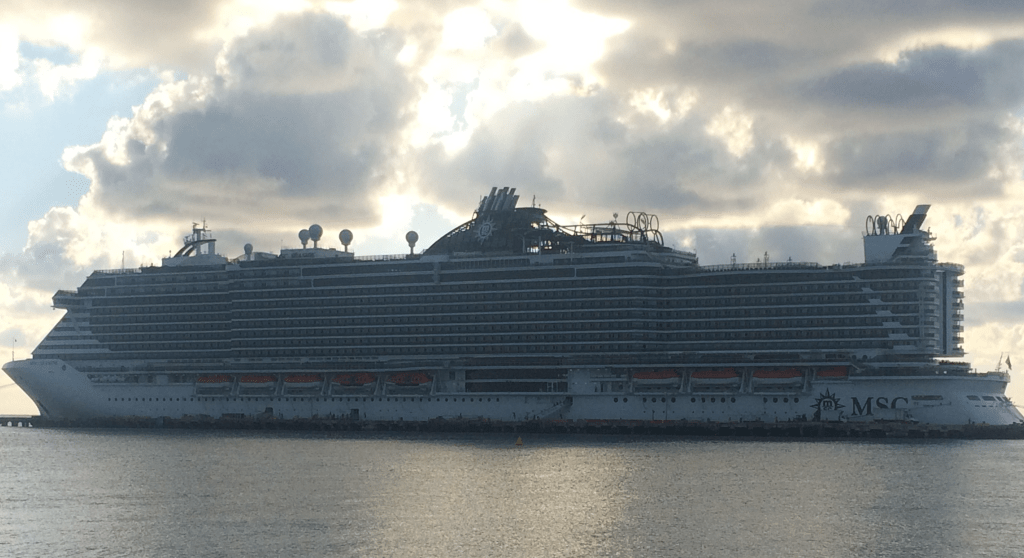
I was walking down the narrow gray-and-maroon hallway of the Seaside after a late breakfast, feeling a little decadent because I snuck a small glass of grapefruit juice out of the buffet to take back to my cabin. As I passed various uniformed crew and officers on the ship, they merely nodded and smiled with polite deference, not even glancing at my renegade cup of juice. I laughed to myself, recalling a case I read about in law school—Krog v. Franklin (1858)—and thinking the cruise ship really is a floating hotel.
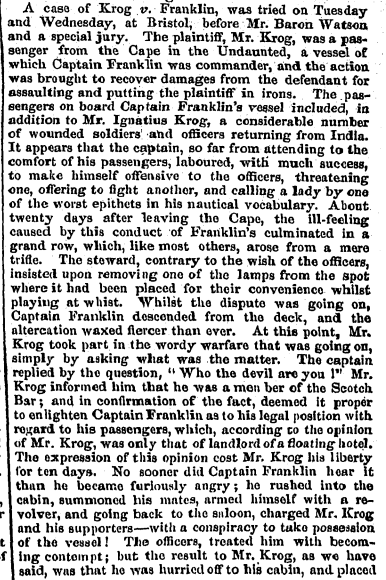
A short version of the story is that Captain Franklin commanded the Undaunted, which sailed in the Spring of 1858 from Calcutta to London. The ship conveyed several passengers, including the Scottish Mr. Krog, as well as British officers and troops that had presumably fought in the recent Indian uprising against the British East India Company. At one point in the long voyage, the passengers were playing a very British game of whist, and the Captain objected to the liberties they were taking in being rowdy at inconvenient times and moving around a lamp for better light. Mr. Krog, who was an attorney, objected to the Captain’s unjust exercise of authority over the passengers, and impugned the Captain’s honor and social status by saying “your ship is a floating hotel, and you are the landlord of it.” The Captain, apparently sensing a mutiny on his hands, flexed his authority further and confined Mr. Krog to his 6’x7’ shared cabin for ten days, chaining his leg to the threshold of the cabin with a 7’ chain. Mr. Krog was offered to opportunity to make peace with an apology to the Captain, but instead filed a lawsuit in Bristol when they returned. The court awarded damages of £375 to Mr. Krog, and a commercial ship master’s somewhat limited power at sea over passengers was duly noted.
Maybe that’s only funny when you’re reading four hundred pages of dense legal text a day with a ten pound legal dictionary to look up every other word, but I delighted in every creative tidbit of writing I stumbled across in those days. The colorful insult stuck indelibly in my memory banks.
A longer, more colorful version of the story was printed in the Times later that summer (as reprinted here by The Hobart Town Daily Mercury) and is well worth the read if you enjoy subtle British humor or the clever use of big words from an earlier era. It rather auspiciously begins:
“Spread as the interests and affections of this country are over so large a portion of the habitable globe, none of us can feel quite sure that we may not be called on some day to undergo that most dreary of all ordeals to a man’s temper, spirits, and self-command—a long voyage in a merchant ship. It is, therefore, a matter of considerable interest to ascertain what the precise limits of the authority are to which any of us may be called upon to submit in one of these floating prisons…”
Apparently there were also ladies aboard, and the Times reported that “one of the ladies, as was dexterously thrown in by the counsel of the plaintiff, having gone through all the horrors of the siege of Lucknow, a fact the relativity of which to the matter in hand we have been quite unable to devise.” (Hahaha… the relativity to the matter, presumably, was the same as it is for obnoxious litigators still practicing today, which is to cloud the basic facts with an emotional appeal as to the overall terrible character of the opposing party in an effort to sway the perceptions of the judge and jury, who are, after all, only human and probably at least subconsciously susceptible to such tactics.)
Incidentally, while searching the internet for information to fill in the gaps from my memory of the Krog case, I found it briefly mentioned by another newspaper, The Leader, which had all kinds of other interesting historical context, from an attack on Mormon elders preaching their mysterious worship on a street corner in Stepney, to a Russian-Chinese treaty, to the “cessation of hostilities between the Boers of the Free State and the Basutos” in the Cape of Good Hope. I love exploring a good rabbit hole, and historical stories as they were perceived at the time are endlessly fascinating. I had no idea why Russia and China needed a treaty in 1858, but a brief search showed that Russia unilaterally annexed the southeast corner of Siberia, and the Treaty of Aigun governed the terms, delineating the Amoor River as the new boundary between the two empires. I foresee many interesting new topics to explore in my to-be-read pile.
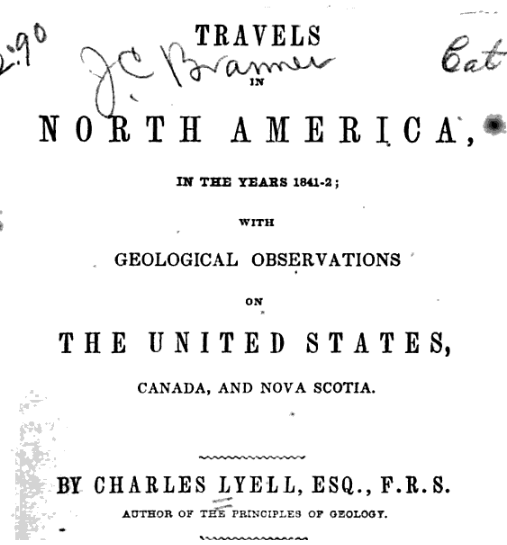
Also incidentally (…see, this is why it always takes longer than I anticipate to finish a simple writing project…) Sir Charles Lyell* wrote a book about his travels in North America in 1841, and he also called the captain a landlord of a floating hotel. This caught my attention in part because I had no idea Lyell traveled to America or wrote about it, and partly because his publication predates Mr. Krog’s use of the phrase, raising the question of where it actually originated.
*Lyell was a geologist and a lawyer (a brilliant combination, if I do say so myself). His Principles of Geology (1830-33) advanced the theory of uniformitarianism, the idea that the slow, gradual geologic processes at work today are the same as they were in the past (“the present is the key to the past”). I had an assignment in college to contrast the opposing theories of Lyell and Georges Cuvier (who championed catastrophism), which I promptly turned into a creative story of the two gentlemen scientists standing at a culvert in the middle of a flash-flood carved channel in the desert, discussing the layered formation of loose sediments and their possible relationship to the nearby rock outcrop. I have a maddening inability to remember names, but when Sir Charles Lyell’s name popped up in my seemingly unrelated internet search, my brain perked up, like, “Hey, it’s Lyell, my old buddy from college! What’s he up to, talking about landlords of floating hotels…?”
Lyell’s journal entry on September 27, 1841, describes a scenic trip on the Hudson River from Albany to New York and the peculiarities of American society, which I found rather enchanting, particularly as an American woman who loves to travel:
“The steam-boat is a great floating hotel, of which the captain is landlord. He presides at meals, taking care that no gentlemen take their places at the table till all the ladies, or, as we should say in England, the women of every class, are first seated. The men, by whom they are accompanied, are then invited to join them, after which, at the sound of a bell, the bachelors and married men traveling en garçon pour into the saloon, in much the same style as members of the House of Commons rush into the Upper House to hear a speech from the throne.”
Haha…which makes me wonder very much what such pouring and rushing looked like, and how the underlying motivations of the hungry American men and the British representatives compared. Lyell, it seems, was not as condescending as Krog when he compared the captain to a landlord.
“One of the first peculiarities that must strike a foreigner in the United States is the deference paid universally to the [female] sex, without regard to station. Women may travel alone here in stage-coaches, steam-boats, and railways, with less risk of encountering disagreeable behavior, and of hearing coarse and unpleasant conversation, than in any country I have ever visited. The contrast in this respect between the Americans and the French is quite remarkable. There is a spirit of true gallantry in all this, but the publicity of the railway car, where all are in one long room, and of the large ordinaries, whether on land or water, is a great protection, the want of which has been felt by many a female traveler without escort in England. As the Americans address no conversation to strangers, we soon became tolerably reconciled to living so much in public. Our fellow passengers consisted for the most part of shopkeepers, artisans, and mechanics, with their families, all well-dressed and so far as we had intercourse with them, polite and desirous to please. A large part of them were on pleasure excursions, in which they delight to spend their spare cash.”
I don’t know that American deference to women is always quite as gentlemanly as all that anymore. I reflected on our formal dinners on the cruise ship, where my chair was held out for me to sit down and the decoratively-folded napkin was placed across my lap, which is not an everyday experience for me. In fact, I’m pretty sure if I counted all such experiences on my hands, I’d have plenty of fingers left over. I also considered the “coarse and unpleasant conversation[s]” I encounter on a daily basis from strangers and acquaintances alike. Those are so common that it rarely occurs to me to take any kind of ladylike offense, and for the most part it is just background noise to the fabric of life. But I have found that my confidence when I travel alone is very much influenced by a two-centuries-long American heritage that is much as Lyell describes. I am generally able to take for granted what Lyell found so astonishing. Not that I don’t feel naturally cautious and hesitant when I visit new places. But each time I do, I find the same unexpected freedom to relax my guard enough to explore and enjoy without constantly looking over my shoulder for danger. That makes it rather a pleasant experience to be “called upon to undergo that most dreary of ordeals” whenever I have the “spare cash” for “pleasure excursions,” hahaha.
 storycapades.com