
“…my future seemed to stretch out before me like a straight road. I thought I could see along it for many a milestone. Now there is a bend in it. I don’t know what lies around the bend, but I’m going to believe that the best does. It has a fascination of its own, that bend, Marilla. I wonder how the road beyond it goes—what there is of green glory and soft, checkered light and shadows—what new landscapes—what new beauties—what curves and hills and valleys further on.”
Anne of Green Gables
Part I: The Enduring Allure of the Red-Haired Anne
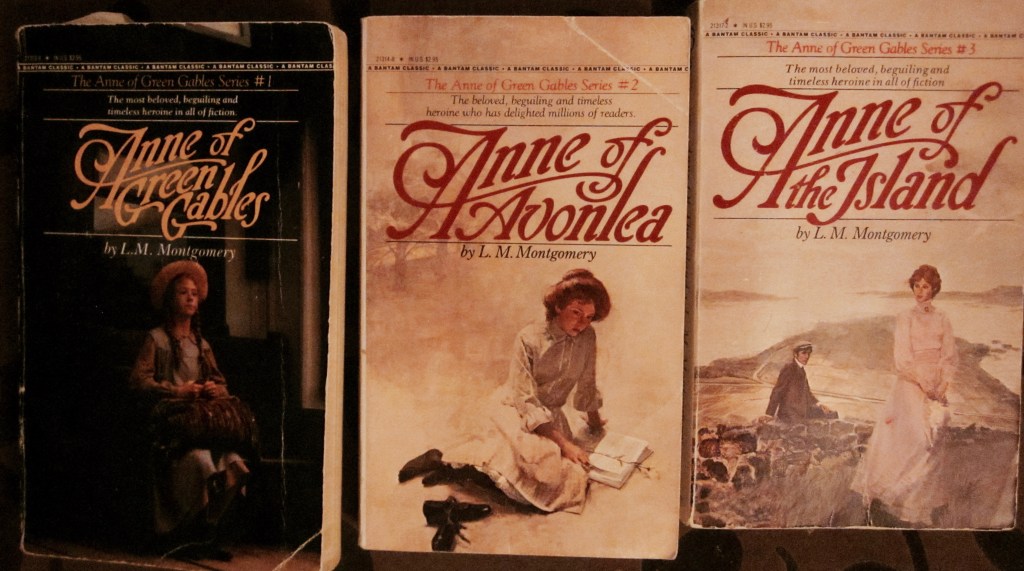
I was probably nine or ten years old when I opened the trilogy of books Anne of Green Gables, Anne of Avonlea, and Anne of the Island on Christmas morning. I immediately fell in love with the precocious orphan who didn’t care that people laughed at her big words, because “if you have big ideas, you have to use big words to express them.” And she didn’t just use big words to say empty things—she looked beneath the surface to the see gritty substance of what things are really made of and why people do and say the inexplicable things they do. Her multi-paragraph monologues felt like satisfying conversations I could soak into my soul like a sponge, when so many real-life conversations felt superficial and enervating. I loved her resilience and deep thoughts and (over-)active imagination… and was a little bit in awe of her predilection for getting into so many scrapes. I avoided trouble quite religiously because the consequences always seemed so… unpleasant… but secretly I longed for red hair and all the adventure and temper and trouble that clearly came with those fiery locks.
A year or so later, I was introduced to the Kevin Sullivan movies, and I fell in love all over again. I still sigh with the deepest contentment every time millions of apple blossom petals fall along The White Way of Delight; when the gold and orange leaves of fall turn to snow covered meadows and fields; and when Anne and Diana stroll down curving, tree-lined dirt lanes. I still gasp a little with the shock of Anne’s slate crashing into pieces over Gilbert’s smug (but swoon-worthily handsome) head; when Anne and Diana jump onto the ancient sleeping dragon of Aunt Jo; when Anne sets her jaw at Josie Pye’s dare and falls off the ridgepole of the roof… and then into covered well in the Haunted Forest; and when the fireworks go into the stove before exploding quite spectacularly. And my heart still swells with squishy feelings of tears and longing and hope every time Anne hugs Matthew in her puffed sleeves; when Anne watches Gilbert leave on the train; when Minnie May spills the heartbreaking news that Gilbert is dying; and when Anne shares the inscription of her book with a Gilbert who is no longer engaged. The movies are quite different from the books… and yet, somehow, Anne is still so very much the same irrepressible spirit.
As a young adult, my best friend and I watched the new sequel, Anne of Green Gables: the Continuing Story. It played on network television, and she recorded it to a VHS tape so we could watch it together, fast forwarding though all the commercials. We were beside ourselves with girlish glee. The sequel took a far different turn from the books, and not everyone appreciated that. I had never read any of the books beyond the first three (because they never seemed to hold my interest beyond the description on the back cover), but THIS… this was like Anne getting to step into the adventures of one of her own stories, I thought. Plus, by that time I’d been married to a man in the military, and I knew what it was like to cope with long silences and partial news and not knowing where my husband was or if he was safe, so I could relate better to this Anne—as she went off to find her husband in the middle of a war—than I could to the version in the books. (Not that I would plunge into the middle of a war like Anne did, but I wholeheartedly understood the sentiment, and was content to let her do the dangerous adventuring, just like she had when I was a kid.) My heart got those squishy feelings again at the end, when Anne peaked around the corner of the train station just like Matthew did all those years ago. I love when stories come full circle and leave me feeling like everything is right with the universe, in spite of all the heartaches and losses and mistakes along the way.
While we were still beside ourselves with girlish excitement, my friend and I decided it would be fun to plan a trip to Prince Edward Island someday. I wanted to see the breathtaking sandstone beaches, where Anne and Diana climbed the sand bluffs covered in tall swaying grasses, and where Anne looked out with deep thoughts over the ocean in the red glow of the setting sun.
It took another couple of decades, but we finally found our way to the charmingly small Canadian island, and it was everything we hoped it would be. Not all adventures are like that, but this one really was. Her mom came with us—“because she loved Anne first, and introduced her to me,” my friend said—and we had such a delightful time together. We stayed a few days in a small cottage in Cavendish, with a porch where we could see the sunlight glinting off the ocean and feel the gentle ocean breezes. We spent many peaceful hours aimlessly strolling along red sandstone and golden sandy beaches. We toured the house with the green gables, with its museum-preserved furniture and drapes and dishes and bedspreads and old-fashioned clothes. We wandered through a hauntingly beautiful forest, and read of Lucy Maud Montgomery’s life and the familiar things that inspired her timeless stories.
It was a magical sort of pilgrimage from our childhood, weaving memories of the stories with the tangible beauty all around us—and we weren’t alone. It wasn’t uncomfortably crowded by any means, but there were substantial numbers of people of various shapes and sizes, parents with children, older couples, young adults. One thing that surprised me was the number of Japanese women and families all around us. Everywhere I turned there were petite Japanese women (making me feel unusually tall), from 8 to 80 years old, their faces infused with the same sense of wonder and nostalgia I was feeling. We exchanged smiles as we crossed paths, sharing a silly sort of enjoyment that transcends language barriers.
One of my roommates in college lived in Japan for a while, and she taught me the Japanese word for nostalgia: natsukashii. She explained that it’s not just an ordinary sort of longing for a place or a smell or a feeling of warmth from a memory—something that you might simply remember with fondness and then move on. Rather, it’s something keenly felt, deeply experienced, poured over and examined. I gathered it was a memory you immerse yourself in and stay a while, feeling all there is to feel until it begins to fade away on its own and the present comes gradually back into focus with a deep, contented, prolonged sigh. It was like that, wandering peacefully through Cavendish, with our thoughts and memories trailing quietly behind us, no hurried agenda or rush to be on our way.
I wandered into a used bookstore in another town, looking for a copy of Anne of Green Gables in French. There was no rhyme or reason to the chaotic order of the books on the shelves, which suited my haphazard curiosity just fine, and I gathered several books into my arms while I continued searching. In the background I could hear the proprietor, an older gentleman, having a conversation with a young lady up front. She had never read Anne of Green Gables, and he was explaining the basic plot of the story and why so many people come to visit Prince Edward Island. My ears perked up when he told her why so many Japanese women and girls come to visit. He explained that after WWII, the U.S. Army wanted to change the way Japan looked at the world, and one of the ways they did that was introducing books like Anne of Green Gables. He said after the war there were a lot of orphans in Japan, and something about the book just resonated with the people there. Thousands of Japanese people visit Prince Edward Island every year.

Aside from explaining the large numbers of Japanese women I saw in Cavendish, his words piqued my curiosity. I have a recurring interest in military psychological operations—not really an educated obsession so much as a lightly focused radar blip that turns my head each time it crosses my path—and the idea that Anne of Green Gables was used in psyops just tickled my fancy. So when I returned home, I started digging a little deeper. Turns out Akage No An (Red-haired Anne) is quite the cultural phenomenon in Japan. She has her own Anime, her own Japanese theme park, and cute little Japanese girls who wear bright red braids in imitation of her. Dunno why that surprised me so much—I mean, I think she’s pretty awesome—but it truly caught me off guard.
And there really is a connection with the U.S. Army and their post-war occupation of Japan. It seems the book itself had already been translated into Japanese during the war by Muraoka Hanako. But it was published and widely distributed as part of an effort to promote a better image of Americans. (We’ll just set aside for the moment the minor detail that Anne was Canadian…) After Japan surrendered, General MacArthur wasted no time ensuring the U.S. Army controlled the flow of of information inside the country, setting up two organizations: “The Civil Censorship Detachment (CCD) which was tasked with censoring pre-publication screenings of print media, and the Civil Information and Education section (CIE) which was tasked with using propaganda to promote democracy in all Japanese media.” (Leo W., The history of U.S. Psychological Operations: Postwar Occupation (Part 5)) Within three months, the CIE had a library (information center) up and running, and within a couple of years, Japanese publishers were starting a new series of foreign literature. There were other interesting girls in the series of 57 censor-approved books, like Little Women and Pollyanna, but “the most eye-catching entry in the series is that of 9 books by one author formerly unknown in Japan,” Canadian author Lucy Maud Montgomery. (Ochi, Hiromi, What did she read?: The cultural occupation of post-war Japan and translated girls’ literature)
“It’s all very well to read about sorrows and imagine yourself living through them heroically, but it’s not so nice when you really come to have them, is it?”
Anne of Green Gables
I’m endlessly intrigued by the power of words to convey powerful ideas, to evoke strong emotions, and to influence our perception of what the world is, and what it “should be.” I took a Literature and the Law class in law school, and it was very eye-opening for me to explore the ways that various books have influenced the way societies perceive what the law is (ideas of fairness, justice, the role of courts and law makers and law enforcers, for example) and how that in turn has affected the ways that laws have evolved over time. Generally, I watch with interest as vague or inaccurate information is conveyed through commercials, articles, movies, and memes—including by businesses, news outlets, politicians, entertainers, and the average social media user—and how people I know personally react. Surprisingly often they will buy things, or buy into things, or argue in favor or against, or share things (sometimes quite passionately) without considering the source of that information, or considering the motives behind the information given, or going in search of additional information the may support or contradict the initial information provided. Not that I’m not equally susceptible, but somehow I seem to be susceptible to different things than others around me, which offers me a little space for objectivity when it comes to their unexpected obsessions with misinformation. This isn’t intended as a moral judgment or pointing of fingers, just a passive sort of ongoing observation that has, in turn, led to an accumulated interest in the more focused and intentional psychological operations in wars both ancient and modern.
As I read about the use of Western books and magazines to influence a whole society in post-war occupied Japan, several complex ideas mulled around inside for a while. Some of them are still mulling and aren’t really organized enough yet to articulate. But two of them I thought I would share here.
One, the surrender of the Japanese Emperor was not the end of the war. It was the date fixed to the end of the war for the official history books so we could be tested in school, of course, but I guess this was the first time it occurred to me that getting out of a war is somewhat more complicated than getting into it. It’s not just about armies and navies packing up their gear and going back home after a handshake and a promise to be nicer about respecting borders, etc. Official declarations and headline news are wispy, insubstantial lines of demarcation between war and peace when people are involved—people who still embody the same resentments and prejudices and carry around the same injustices, people who could launch everyone right back into war if they don’t like the declarations and headlines. Appeasing or controlling or shifting those mindsets is both more and less of a monstrous task than I might have supposed, had I thoughtfully considered it beforehand. More, because how can you possibly hope to reach every individual in a huge population and change their hearts and minds, when you don’t know anything about them? And yet also less, because we humans (on the whole) are remarkably susceptible to the simplest of tactics. At least, it seems that way to me right now.
Two, I initially thought (years ago) of psychological operations as “fighting dirty”—which didn’t necessarily bother me (depending on the context and whose side I was inclined to support)—but that has expanded over time into something much more complex that doesn’t really have a label in my mind yet. I am distressed on a visceral level about the selective control of information (censorship, though it is not always called that), I think because a core part of my personality is to be curious and explore. Preventing my access to information, hindering my ability to see all sides of an issue or process or thing, limiting my personal freedom to consider whether to accept or reject ideas as valid or foolish over time, is an anathema to all that makes me who I am. The idea that these tactics were (…are…) used to promote democracy is discomfiting. But… I also see that people do not often act in rational ways, particularly over the short term. I see that the human race has an appallingly-consistent tendency to hurt others. I can observe that controlling the timing and amount of information, while it makes me squirmy inside, also offers a sense of order and safety and civilized behavior. That is an uncomfortable truth I will probably continue to wrestle with for the rest of my life.
As I consider the lasting impact of the Red-Haired Anne on generations of Japanese women, who made the same nostalgic trek to Prince Edward Island that I did, I recognize that I would pass those treasured books on to my own offspring and hope that they find a similar sort of joy in the words that I did in my youth, that it helps shape their view of the world and the people in it in positive ways. At the same time, there are other books I would probably not be as interested in passing on because I did not find the same value in them. And that, too, is a selective sort of controlling information. This gives me much food for thought, about motives and degrees of control, and the powerful influence of words and ideas to shape our world.
“Isn’t it splendid to think of all the things there are to find out about? It just makes me feel glad to be alive–it’s such an interesting world. It wouldn’t be half so interesting if we know all about everything, would it? There’d be no scope for imagination then, would there?”
Anne of Green Gables


I love this! It’s remarkable the influence that one literary character can have over so many lives. Anne has brought so many of us together ❤
LikeLiked by 1 person
Cheers to another kindred spirit! 🙂
LikeLiked by 1 person