
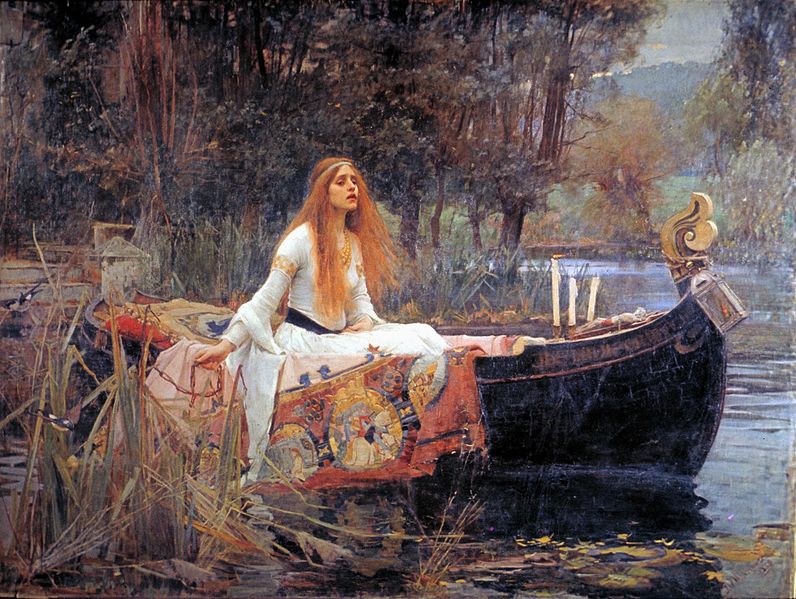
There she weaves by night and day
A magic web with colours gay
She has heard a whisper say,
A curse is on her if she stay,
To look down to Camelot.
She knows not what the curse may be;
And so she weaveth steadily,
And little other care hath she,
The Lady of Shalott.
~Alfred, Lord Tennyson
Unlike Anne Shirley—who reads and quotes (and reenacts) Tennyson’s poem with such memorable panache—I don’t love poetry. I didn’t purposely set out to not love poetry, it just kind of happened without any effort at all. Not that I haven’t tried some sincere effort to see if it makes a difference. But there’s just so much of it out there that feels dreary and dull, that practically sucks the energy from my soul to have to drag myself through it from beginning to end. For a long time I felt a heavy sort of moral-cultural responsibility toward poetry. I felt like my personal character must somehow be flawed for sulkily avoiding the drudgery of all the generally-accepted great poets.
Shakespeare, for example, makes my eyes roll back into my skull and get stuck there, with a dramatic snore of boredom. How could I not love Shakespeare? Everyone loves Shakespeare. People tell me I just “don’t understand it” because of the archaic language, but I get the language fine; I just don’t like the content. Beautiful phrasing isn’t enough to engage my mind with mind-numbingly dull and inapplicable subject matter.
I keep thinking there’s hope for Shakespeare…perhaps as I mature or gain life experience or greater patience for suffering through difficult things. In my Literature and the Law class we read the Merchant of Venice. While I do appreciate understanding the concept of “a pound of flesh” on a whole new level, what really intrigued me were the words of a classmate who majored in English for his undergrad and Knew Stuff about Shakespeare. He talked about layers of information: that there was a surface layer to entertain the public, but more subtle layers to convey deeper information to those paying close enough attention. THAT piqued my curiosity. Not enough to actually go looking (as of yet), but still, the potential is there.
And then dear Patrick Stewart, who is, hands down, my favorite starship captain ever, recently decided to read a sonnet a day during the social distancing phase of a worldwide pandemic. Up until that point it hadn’t even occurred to me that I could follow my favorite captain around on Twitter, but there he was, making Shakespeare famous and interesting. (For me, I mean.) (Honestly, it felt rather reminiscent of that Moebius alternate reality in Stargate SG-1 when Rodney McKay tells Samantha Carter, “Now you – you I would listen to if you were reading the phonebook.”) (Uh, only way less creepy.) But you know, even enjoying Patrick Stewart read the words, I still don’t feel like I’ve jumped on the Shakespeare bandwagon. (I laughed with sincere appreciation when the good captain skipped over sonnets he just didn’t like, pointing out that no one was going to make him read them. So there.)
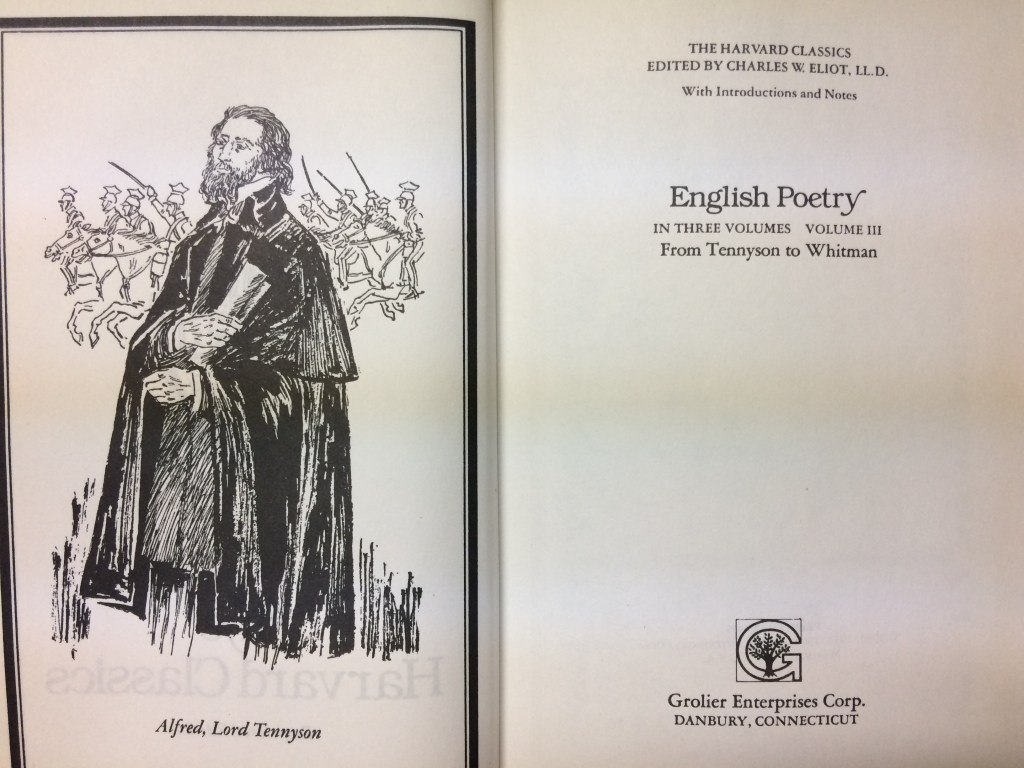
I did learn to love the Lady of Shalott. I have a book of “English” poetry, full of recognizable names like Tennyson, Robert Browning, Emily Bronte, Charles Dickens, Robert Louis Stevenson, William Cullen Bryant, Edgar Allen Poe (I loved reading his stuff in Junior High), Ralph Waldo Emerson (I wrote a paper on his stuff in college), Henry Wadsworth Longfellow (who, it turns out, wrote The Wreck of the Hesperus), and Walt Whitman (I wrote a paper about his stuff in college, too). I’ve had the book since the mid-1990s, and have been meaning to read it since then.
The salt sea was frozen on her breast,
The salt tears in her eyes;
And he saw her hair, like the brown seaweed,
On the billows fall and rise.
Such was the wreck of the Hesperus,
In the midnight and the snow!
Christ save us all from a death like this,
On the reef of Norman’s Woe!
~ Henry Wadsworth Longfellow
One calm Saturday morning about a decade ago I found myself with an unusual amount of unexpected free time, and as I perused my overstuffed bookshelves my eyes landed on the old hardbound volumes of poetry. Somewhere along the way I designated a “poetry journal” (I have journals for everything) to collect my thoughts, and there it sat on top of dusty poetry books, pastoral pastels on the cover and utterly blank inside but for pre-printed quotes from the Brontes: Anne, Charlotte, and Emily. Clearly, my progress in learning poetry could not even be measured, it was so insignificant.

I cracked open the unused volume of Harvard Classics poetry, and there on the first page (after the introductory mumbo jumbo) was a poem titled “The Lady of Shalott.” Confession: I didn’t immediately make the connection between the poem and Anne of Green Gables. It was “there she weaves by night and day” that I distinctly heard in Anne Shirley’s voice that finally caught my attention and pulled me out of the drudgery-drenched perspective. I had to go back to the beginning to read the poem again, with new eyes, thinking about Anne nearly drowning in a leaky dory and being humiliatingly rescued by the swoonworthy Gilbert Blythe. Not that THAT scene had anything to do with the poem….
….except it really very much did. It completely changed Tennyson’s poem, hearing it in Anne’s voice. It was like magic. I didn’t realize that *my* context mattered, that what *I* brought to the table could make a difference to how I perceived poetry. I always assumed poetry was supposed to be objectively good, well-written, critically acclaimed, universally accepted. Somehow it never occurred to me that there was a completely *subjective* element. That I could be *picky*. That it wasn’t an all-or-nothing package deal. It was kind of…liberating. In a gradual sort of way.
Around the same time I started listening to a Pandora station I labeled “New Age.” It actually started out with New Age stuff like Enya, but spiraled outward to include Baroque-Classical-Romantic music and instrumental movie soundtracks. One day, maybe a few months after reading Tennyson’s poem, Pandora started playing this long song by Loreena McKennitt, and since it was background music—the soundtrack to my life—I didn’t really notice at first that she was telling a story. At some point my attention was caught by the repeated refrain, the Lady of Shalott, and I honed in, realizing she was *singing* Tennyson’s entire poem. The whole thing. Start to finish. And it felt like a *story*. Suddenly I wanted to know this weaver, this woman who could only see the vibrancy of real life through muted reflections. As I listened to Loreena McKennitt sing over and over again, my soul felt like unnamable hurts and longings were being articulated, things that had nothing to do with Camelot or weaving and everything to do with personal vulnerable feelings I kept securely locked and out of the way.
Later I learned that old poetry used to be sung. I don’t know if that’s true or just speculation (how would anyone really know if they weren’t there to hear it?) but it made perfect sense. And also opened my eyes to lyrics as another form of poetry. (I’m currently attempting to tackle Opeth, Meshuggah, and Iron Maiden as poetry—which is admittedly daunting, but somehow a challenge far more intriguing than donning hip waders for a slog through O Captain! My Captain!, my love for Robin Williams and Abraham Lincoln notwithstanding.)
A couple of years ago (poetry and I have only a passing acquaintance, really), I discovered some military-inspired poetry that reached right into the deepest part of my soul and pulled my guts out through my throat, made me rethink my battles with internal demons, insecurities, faults, fears, and pitiful efforts to stand my ground in a whole new light. It also made me start to question my default assumption that I “hate” poetry. I’m starting to realize that when poetry resonates on an emotional, visceral level, and articulates deep meaningful things I have no words of my own to express, that those poetic words become woven into the very fabric of my soul. For example, Luke Ryan writes this poem in The Gun and the Scythe about a Hooded Figure who comes to a soldier on the battlefield and lets him know it’s okay to let go of his rifle, honoring his hard sacrifice and offering a surprisingly gentle step into the unknowns of death.
Theo Dyssean—aside from giving me poetry that gave expression to my faltering hope that it is okay to step out onto limbs that ultimately break and to stubbornly persist against the demands of conformity —also raised my awareness of different forms of poetry. I took a couple of creative writing classes in high school and college, and I probably learned only the most basic forms of poetry: haiku, sonnet, limerick, diamante, ode, acrostic, cinquain, epic, ballad, free verse. We practiced writing our own, of course, and while I loved the structure and finding new ways to arrange my thoughts and exchanging words and nuances, I don’t know that I was particularly good at it. In high school I got all A’s, but my college professor had higher standards and told me my attempt at “free verse” was prose, not poetry, which left me confused about the rules distinguishing the two from each other.
Theo’s poetry had both substance and structure that appealed to me, but did not quite fit into the familiar forms of poetry I thought I understood. I went looking further and discovered several hundred forms of poetry I’d never heard of before. I was stunned. Do people just make this stuff up? Like, isn’t there some sort of poetry gatekeeper who says, “Nope, this one doesn’t pass muster, back to the drawing board for you.” For now, I’m still a little baffled by the line between adhering to rigidly accepted forms of poetry and creatively breaking the rules to take poetry in new directions. But I find that new structural territory appeals to me (…even though I sigh at the thought of picking through old structures for the sake of understanding them so I can better appreciate the new structures…)
I’m reading a book about Skaldic poetry that is almost overwhelming in its unfamiliar form, but I absolutely love that no one has ever made it a culturally oppressive dark cloud, so I feel completely free to love it or hate it or develop my own independent thoughts and opinions, with no pressure to think anything at all. (And by “reading” I mean that I started it last year and I’m all of 23 pages into an introduction that is still talking about kennings, alliteration, assonance, meters, stanzaic patterns, and heiti.)
About 15 years ago I listened to an unfamiliar poet, Li-Young Lee, give a speech at my university about poetry, called Infinite Inwardness. At the time, most of what he said about poetry didn’t really register, probably because my brain was focused on more immediate scientific things. But as he read one of his poems about breathing and a relationship with diety, it so fully captured my insides that I became a captive audience, and wondered how he knew what was in my heart. A few months ago I went in search of other poetry he wrote, curious if any of it would resonate in a similar way—curious if one can have a favorite poet who always writes things that hit the sweet spot, or if each poem must be handled one by one. So far, it seems like each poem is a unique individual. I did enjoy some of his other poems, but many others did not stand out in any particular way. I went back to listen to his speech, and since I’ve been making a greater effort to understand poetry recently, some of what he said made a little more sense. I wrote down some of his words in my poetry notebook (which isn’t a verbatim quote, but the general gist of what he said is there):
When we inhale, we feed on the air, and our skin and blood and bones and muscles become alive. When we exhale, our bones and muscles soften and nutrients begin to leave our skin and our blood. The tragedy of this is that when we speak, we speak with this exhaled breath. So while we feed on the world in silence, when we speak about the world, we have to exhale. The more you say, the more your meaning gets divulged. So that meaning grows in opposite ratio to vitality. The more I speak, the more out of breath I get, but the more my meaning grows. This is a tragic situation, and inescapable. It’s a paradigm for human living. As we die, the meaning of our lives gets divulged. If it’s divine meaning, that’s a way to ransom this dying to make it more worthwhile. I think people who write poetry are anxiety-ridden about this, and try to pack as much content into the divulged meaning as possible. That can become so compacted it escapes the intellect. You end up spending years unpacking what those poems mean. That is poetry’s difficulty and its gift. In that way, it’s like DNA. It’s really tiny, but there’s a lot of information packed into it.
This may also be paradigmatic of our relationship to the godhead. It seems the more we manifest divinity in our own lives, the more our temporal self gets displaced. When you breathe in, your body feels really comfortable. In fact, you could inhale for–my father could inhale for up to three minutes, and exhale for three minutes. He taught us to do this practice. You should try that, when you’re praying. Do the inhalation and exhalation. It’s a crazy experience. Anyway, when you inhale, the ego is affirmed. The body feels very present. And when you exhale–if you exhale to completion, most of us don’t unless you do it very consciously–you begin to discover that you become very uncomfortable. Your body begins to grasp for breath. I find it interesting that the ego-mind has to get displaced in order for meaning to disclose itself.
Li-Young Lee, Infinite Inwardness (2004)
Somehow, I really like the idea that poetry isn’t intuitively obvious, that maybe you have to work to understand, to unpack the meaning there. Because at first glance, poetry rarely holds any meaning for me at all. Sometimes I have to get there in a roundabout way, introduced by movie characters or songs or friends willing to share their passion, their why behind the significance of the poetry. I don’t often enjoy poetry on it’s own, objectively, for it’s own sake. I have to bring something to the table that matters to me, and my something and the poem’s something have to somehow connect. And then… it’s almost as if the poem unpacks what is inside of me as much as I try to unpack what is inside the poem. That’s an adventure of an entirely different kettle of fish.
“Did you ever read one of her Poems backward,” asked Emily Dickenson of an unknown interlocutor about an unidentified poet, “because the plunge from the front overturned you? I sometimes (often have, many times) have—A something overtakes the mind.”
~James Logenbach, How Poems Get Made
————————–
Despite the (somewhat lengthy) two-part nature of this article, I don’t actually spend a great deal of time reading or watching Anne of Green Gables or Anne of Avonlea or Anne of the Island or The Continuing Story. It’s probably been a decade or more (an oversight I might remedy in the near future; I’m feeling a little nostalgic as I write this.) I did repeat them frequently as a kid and a teenager, though, much to my brothers’ vexation (“You’re watching that movie *again*? But you’ve already *seen* that one.” Pfsh. As if once is enough.) As an adult I find that the stories of the red-haired Anne continue to influence my life in subtle ways—like developing the inner courage to have adventures of my own—and that certain phrases or passages regularly creep into my vocabulary, so that the books and movies form fairly significant threads in the fabric of my life.
“When I was a little girl, I remember an old faded print on my uncle’s wall, showing a string of camels around a desert with a palm spring. I’ve always wanted to travel and see that place. To see the Taj Mahal, the pillars of Karnak. I want to know, not just believe, that the world is round. But I can never do it on a teacher’s salary. I shall have to go on forever prating about discipline and the inexhaustible resources of the dominion.”
~Catherine Brooke, Anne of Avonlea
 storycapades.com
This is wonderful reading.
LikeLiked by 1 person
Thank you ❤
LikeLiked by 1 person
You’re welcome.
LikeLike
This is fabulous!! Thanks!
LikeLiked by 1 person
Amazing work!!
LikeLiked by 1 person