

I have a special knack for utterly embarrassing myself beyond the normal tripping over my own two feet thing, which also happens. I think it’s genetic. I have exhibited this delightful gift repeatedly in work situations. If you are expecting another edition to the stories where someone doesn’t realize that their pants-less glory is visible in their business video conference, you will be disappointed. Our daily work meetings are gratefully free of video altogether. We are able to hear one another and share our computer screens, but if my fellow coworkers are dressed in either a Chewbacca or a birthday suit, I am none the wiser. Nevertheless, I still have adventures.
One of them involved hearing the engineers discuss a project. It didn’t really apply to me, per se, so I wasn’t being altogether attentive at that particular line of discussion across a couple of day’s meetings. In that inattentive state, I vaguely noted my colleagues repeatedly using a term that sounds like lumberjacks were using cookware instead of axes. Since that was altogether illogical, I wondered if it was a term for attaching those pails to maple trees to collect maple syrup.
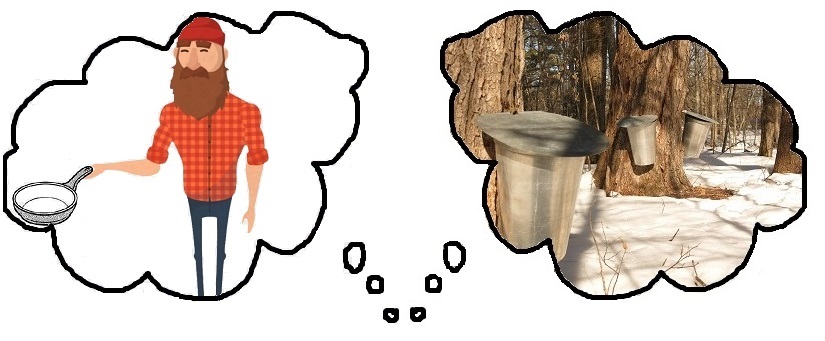
Tree panning? Seriously?
After longer than I care to admit, I had an “ah ha!” moment. I realized they were using a term I knew, but pronouncing it differently than I did. Trepanning. I have been pronouncing that like treh-pun-ing. This is one of the dangers of knowing words largely because you’ve read them someplace but haven’t heard them said aloud. Once I realized what they were saying, my confusion only got worse.
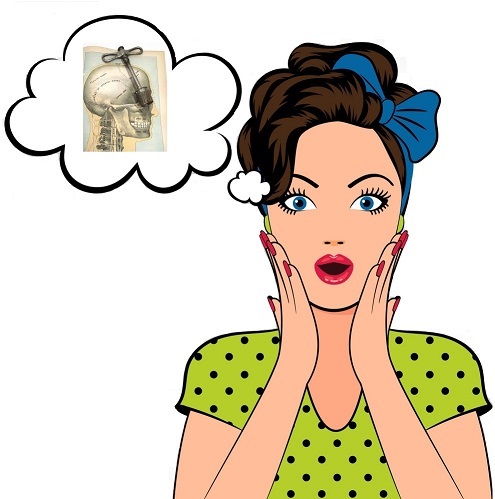
Trepanning, as far as I knew, was a medieval-sounding medical procedure involving the use of an auger to perforate the skull to release pressure on the brain. I couldn’t imagine what this had to do with engineering at all. At this point, I finally acknowledged my ignorance and asked to be enlightened.

It was explained that trepanning, in a manufacturing sense, is when you remove material from an existing piece of material while also leaving material behind. Unlike boring, which creates only a hole, trepanning creates a hole and still leaves a piece. The picture to the right is an example of how this could look. The rectangle hole is not all the way through the hexagon, so the oval stem remains attached to the main block of the material. The act of creating that rectangle hole while leaving the stem intact is trepanning. It was a bit of a rabbit hole of confusion that was eventually unraveled and clarified.
I’d like to say that’s the only time I had one of those uncomfortable “oh, that’s what you meant!” experiences, but it wasn’t. Some years ago I read the term “facetious” in a novel. I didn’t recognize the word and this was before the invention of an e-reader with a built in dictionary, where you can simply press and hold on the word for the dictionary to pop up and enlighten you on both the meaning and the pronunciation. I was stuck with old-fashioned context clues.

I determined that the word was facet-ee-us, or multi-faceted, like a diamond. In the context at the time, that fit. Something that was being said had multiple layers of meaning, like how light can bend through a diamond differently based on the angle.
Having learned this word, I actually used it. In public. More than once. Nobody ever corrected me. It was later (much, much later) when a friend kept using the term “fuh-she-shuss” that I asked what it meant and I discovered that it was my beloved facet-ee-us (facetious) pronounced and defined correctly.
I mused that it would be nice if books just had handy little pronunciation guides on these exciting words, but if we’re honest, who would ever use it? In fact, *cough*, I purchased a book that had such a thing. The book was highly recommended to me by multiple friends. I knew other works by the same author, so I bought it with enthusiasm. The book came with a pronunciation key at the beginning. It spanned pages. Yes, pages. Character names and place names. PAGES. I didn’t even finish the book. If there were that many characters and places that would be difficult to pronounce, I just didn’t feel up to the task. Ain’t nobody got time for that.
And yet, don’t I have time for that? It sure would have been helpful with Hermoine. Reading Harry Potter, I wasn’t really clear on that one at all. “Is it Hermoyne?” I wondered. Or maybe like Her-mine. This pronunciation makes me think of Tarzan. “Me Tarzan. You Jane. (pointing to her in an aside to his faithful ape friend) Her mine.” There’s no way I would have come up with Her-my-knee. Like, whose knee is it anyway?
 storycapades.com
Hahaha… Your I-don’t-think-that-means-what-I-thought-that-means stories are always my favorite.
LikeLike