
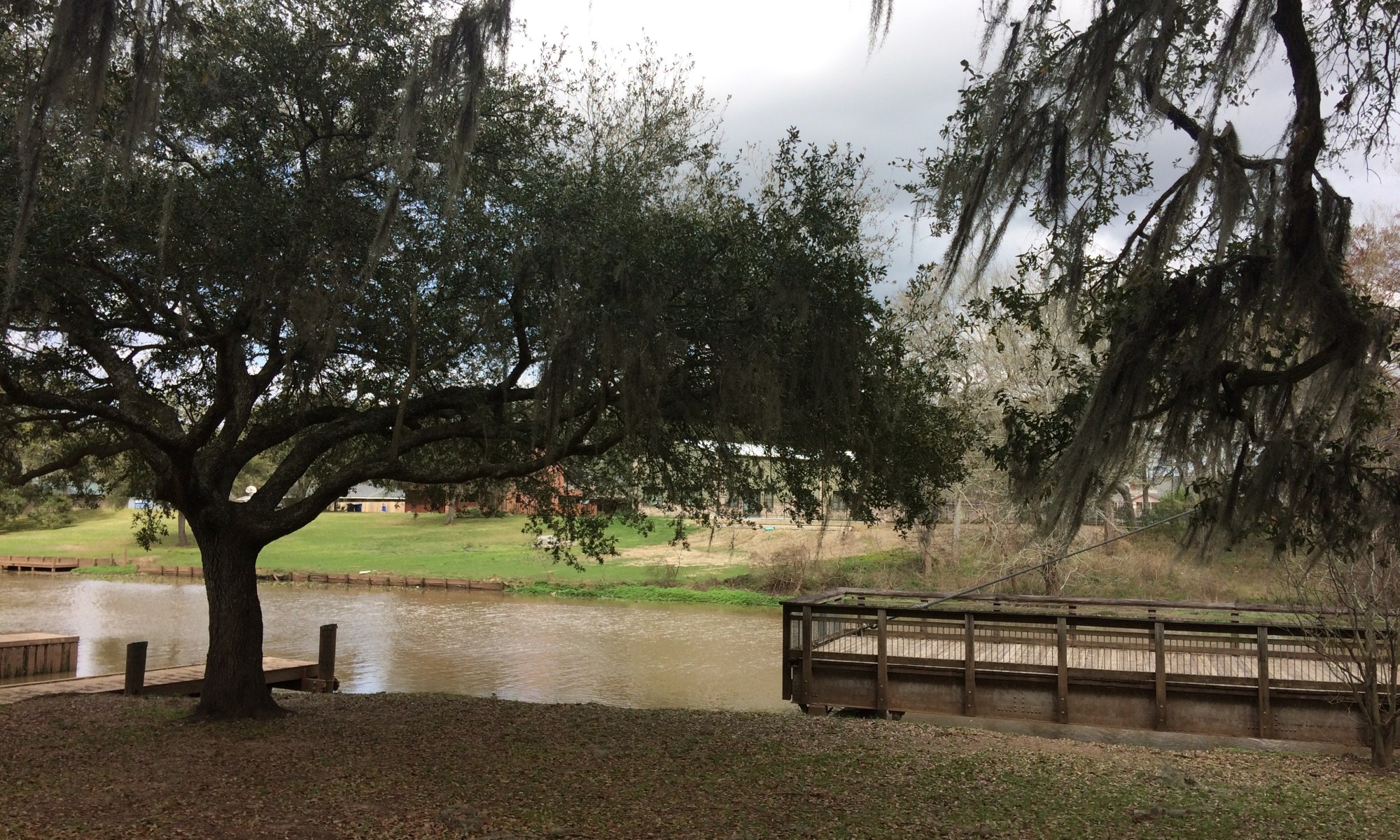
Travel Inspired by a Story Character
A few years ago I found myself in the position of needing a reporter in one of my stories. Trouble was, I needed someone my other characters would actually trust enough to speak to him or her. This turned out to be a tall order, partly because I have a personal aversion to reporters and they way they mischaracterize facts to create news–a trait that has affected my life in personal ways. This suspicious, wary quality had already been subconsciously woven in to the characters of this particular story. (Not on *purpose,* it just crept in, and I couldn’t undo it at that point, not without scrapping all the things I loved about these characters.)
I don’t actually have many French characters, but this one needed to be well-traveled and a bit of an outsider, and France seemed like a good home base for some reason. Then I realized I needed this person to have American citizenship as well—it just made things easier. Oddly, it took a while for me to settle on a suitable anchoring state, but when I picked Louisiana, everything about this character seemed to click into place, including the decision to make the reporter female as well as an investigative journalist.
I didn’t even really know what an investigative journalist was, other than that the authors of a handful of books I’d read said they were investigative journalists. I started to learn a little more about familiar (or vaguely familiar) names like Ida B. Wells, John Howard Griffin, Bob Woodward and Carl Bernstein, Nellie Bly, and several others. It was interesting and educational. I found that I liked their general tenacity to stick with a subject for longer than a modern news cycle, and that they really rolled up their sleeves to do the tedious, thankless work of bringing complex information to light in a readable, relatable, and digestible way. Bless them.
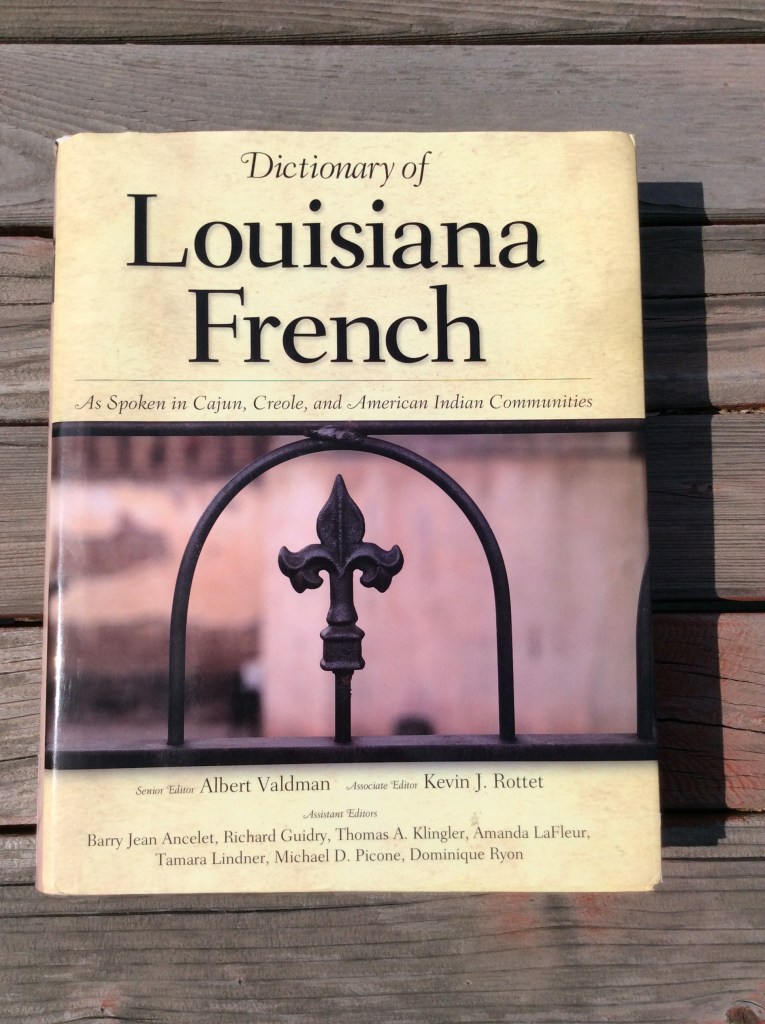
I also hunted down a Dictionary of Louisiana French. I knew there were differences between Louisiana French and the standard French I’d learned in school, but I’m not really sure why it seemed so important to obtain an entire dictionary to ensure authentic diction for (what was then still) a relatively minor character. Except that I like dictionaries, and I seem to be acquiring quite a collection of them in a variety of languages. Mostly it just sat there for a year or so collecting dust next to my other French books, until I encountered a friend who spoke Cajun French. Then I found myself cracking it open nearly every week to discover fascinating new words I could put to practical use.
“Those of us who really love literature cannot help having a keen relish for the dictionary. It may tempt us to desultory reading; but it is certain always to reward us if we are properly receptive and if our curiosity is as alert as it should be. We cannot consult it without an immediate increase of information; and we always find it full of ‘good stories’…”
—Brander Matthews, Vicissitudes of the Vocabulary
Most of my story characters actually hail from places I’ve lived before, which makes it easy to write their point of view. I feel like I’m entitled to make authentic underlying assumptions related to their home environment and culture, seeings how it’s my own environment and culture. It’s the characters that don’t that get tricky, because there’s really only so much one can glean about an unknown place and culture from books, photographs, maps, and lists of slang and favorite foods. It’s a nice start as far as research goes, but Louisiana seemed so vastly different that I felt I really needed to go there. (By this point my little investigative journalist had grown into quite a powerhouse character… and I kind of looked up to her, as much as anyone can look up to a fictional character of her own creation.)
In law school, we frequently talked about how Louisiana laws were the exception. We could generalize a lot of state-based laws, grouping them together so that a large number of states might lean one direction, while another large number of states leaned a different direction. And THEN there was Louisiana, nearly always an outlier with its remnants of Napoleonic Code and marching to the beat of its very own drum. The pervasive wisdom of the day was that if you want to practice law in Louisiana, you should start by going to law school in Louisiana.
In geology, we occasionally talked about New Orleans and the vagaries of the meandering and flooding Mississippi River. Aside from some fascinating geophysics in the New Madrid seismic zone located upstream, our focus was generally the tenuous balance between feats of engineering for economic prosperity, and the relentless pressure of nature as the captured river delta frequently created (…creates…) problems faster than man could find the money, ingenuity, and collective willpower to solve.
But knowing a handful of random facts about a state–that I honestly couldn’t even pick out from a lineup of southern states on an unmarked map–seemed a poor substitute for being there in person, experiencing the humidity, scents, flavors, music, and accents firsthand. So I decided to be brave and plan a four-day weekend to explore.
Backstory Detour
I went to Louisiana in February over President’s Day weekend, and flew into Alexandria, just above the ankle of the boot that makes up the shape of Louisiana. I worked on my day job in the early part of the day and flew out that afternoon, and didn’t arrive until shortly before midnight.
Mm. I’m realizing as I write this that arriving in an unfamiliar place in the middle of the night is an unfortunate pattern that leads rather predictably to traveling insecurities compounded by fatigue.
[*Scribbles mental note to self…*]
It was late enough that the relatively small airport was mostly dark, the handful of restaurants, shops, and ticket counters closed for the night. It took a few minutes standing in line at the car rental help desk for someone to arrive at the airport and help us. The two dark-skinned men ahead of me in line were tall and sort of muscular-turned-domestic, as though maybe they once played sports and worked out, but now enjoyed home cooked meals and kicking back in front of a television to relax. They kept turning back to look at me, and I knew it was me because there was no one else in line, hardly anyone else left in the airport.
(I have to go through this mental checklist automatically, because I’ve made the mistake countless times of thinking someone was smiling or waving at me, or talking to me, and it’s just super awkward. But I really hate to be rude in case any of those things actually are directed at me, because any social interaction I don’t have to initiate is a social battle half won before I even muster to join. Diligenter circumspice THEN carpe diem. That’s my motto for social stuff.)
I’m generally pretty guarded and wary with men I don’t know, but I find that if I walk a careful line between genuinely polite and clearly-not-interested, most men will steer clear of pushing their luck. I don’t hate men, I think they’re quite wonderful, and I have brothers and cousins and uncles and friends aplenty. Some of them (the men who are strangers) just have a disconcerting knack for pouncing on the slightest encouragement and persisting until they get what they want. Which, when there’s mutual interest, can be remarkably fun. And I’m generally good-natured enough not to resent the ones I’m not interested in for trying–how horrible would it be if men stopped trying??–as long as they respect my boundaries. (And I don’t mean to give the impression that I’m stunningly gorgeous and men regularly fall at my feet. Snort. I’m actually quite plain and ordinary, and content to go months or even years at a time without navigating the dance of the sexes. I appreciate the luxury of flying under the radar of that kind of attention most of the time.)
Gracefully sidestepping verbal flirting and innuendos and pick up lines can be tricky–and occasionally a little flattering. But this was an altogether different experience for me. I wasn’t really afraid of these men, and they weren’t leering at me or threatening me in any way… except perhaps my equilibrium. They were just… looking. Admiring. Appreciating. Leaning against the counter and glancing back with these soft-eyed smiles that lingered. I felt ridiculously…feminine. Maybe that’s not the right word, but for the first time in my life I almost felt the urge to flutter my eyelashes or something. I’d probably lose a contact that way. After they got the keys to their rental car and started walking down the hall, I caught one of them looking back almost wistfully, and I wanted to laugh and tell them I’m not that much of a prize; I’m too prickly and full of independent thoughts and restless with all the things I want to do to appreciate those kinds of glances with equanimity for more than a few minutes.
I signed for my rental car and was on my way, the masculine British voice of Siri on my smart phone guiding me through the darkened city toward my inexpensive hotel. I drove for quite some time down a wide divided road with a large grassy median in the middle, and long distances between street lights and cross roads. I started itching for a paper map so I could picture the whole route inside my head. Partly just because I like maps, and partly because this was somehow more rural than I had imagined, and in my experience, rural doesn’t often play well with cellular service. I also started feeling uneasy, traveling on my own without a rigidly set schedule of things to do. I had some ideas of where I wanted to go, things I might try to see, but four unstructured days of story research stretched out in front of me, and that was surprisingly uncomfortable. It had seemed like a great idea in the comfort of my home, surrounded by my things, to imagine exploring the unknown and giving myself plenty of time to discover what looked interesting once I got there. Now I was here, and it was dark, and nothing felt familiar, and I felt unexpectedly alone and almost fragile. I suspect most of that was just being tired after a long day and needing a good night’s sleep.
I checked into the hotel, which was old but clean, and the reception area was decorated with purple and green Mardi Gras masks and confetti and streamers. It was a little splash of festive color in an otherwise drab hotel. The receptionist who checked me in was tired but kind, and spoke of her grandkids while getting all the paperwork in order. I liked her. I made my way through long hallways and around corners and up an old creaky elevator, down more hallways and corners. It wasn’t long, I was just tired. And the sounds of arguing and weeping and impaired speech at the end of the hall near my room made me brace myself, associating some of those sounds with drug use and wondering if this was going to be a long night. I took a hot shower in an old chipped heavy porcelain tub with converted plumbing, and by the time I got out, most of the sounds had settled down to a murmur, and I was finally able to fall asleep.

The next morning I started searching for a real map, the kind that doesn’t require a power source or gps signal. I had plans to tour a museum with an early appointment, but I still had some time to kill and thought it would be easy to find a place that sold maps. I was wrong. I wasn’t picky. I was picturing one of those state road maps folded like an accordion into a brochure size that would do the job, but I was open to alternatives. I started at a nearby gas station. I walked in and briefly looked around, but it was pretty small and I couldn’t see anything like a map. Honestly, I dread having to ask strangers for help (it’s complicated and stupid, and persists despite logical efforts to talk myself out of the dread) but I really wanted that map. So I put my big girl pants on and turned to face the guys that had been chatting up front. They were staring at me, which caught me completely off guard. They weren’t looking at me like I was weird, which happens all the time (although I wasn’t actually *doing* anything weird, this time) but… like they’d never seen a woman before. Kind of… moony-eyed and a little slack-jawed. I’ve never in my life gotten *that* kind of reaction before, and I had no idea what to do with it. One of them was wearing a ball cap over long greasy blond hair and was missing several teeth, and the other instantly made me think of Billious Button Buster.
Billious Button Buster was a character in an old comedy monologue my paternal grandmother used to perform for talent shows and various other events. When I was a kid and we had family reunions with a couple dozen cousins and aunts and uncles, she entertained us with a southern drawl she’d earned fair and square by serving a church mission in the South for a couple of years before returning home to get married and have children. She put on a wide-brimmed straw hat, blacked out a couple of teeth, and became Little Sis Hopkins, from Skinny-Marink Crossroads, down in Toad Huntin’ Holler… and she was a *hoot*. Billious was her beau, and as she so eloquently phrases it, he’s a big feller: “He ain’t so big up and down, but he shore is a whopper ‘round the middle.” I used to think that this was an exclusive show unique to our family, and was disgruntled as a young adult to discover that lots of people have heard the horrifically funny execution of “My Bonnie Lies Over the Ocean.”

Anyway, back at the gas station, “Billious” was looking at me, his light-colored belly hanging out the bottom of his t-shirt, with an expression that suggested he wanted to take me home and put me on a pedestal, and all I wanted was a map. The two of them didn’t seem unkind or malicious in any way, and I didn’t want to hurt their feelings, but I was completely perplexed. I knew there wasn’t anyone else in the small building, so there was no use in looking behind me to see if there was some hot slinky model standing behind me who might have merited that kind of look. I certainly didn’t. I wasn’t even wearing makeup or nice tailored clothes, just the usual jeans and a comfortable t-shirt and twenty extra pounds from long days sitting behind a desk. The mutual staring had crossed into awkward territory–but I’ve pretty much earned that territory under the terms of the Homesteading Act–so I pulled out my pitiful reserve of courage and asked if they had a road map. They seemed a little dazed for a moment, like they’d never heard of a road map before, but then concluded that they didn’t have one there at the gas station. I hated to pester them any further, but managed to ask if they knew anywhere around there that might sell maps. After a few moments of hemming and hawing, one of them suggested the drug store a little ways down the street. Turned out the drug store several miles away didn’t have maps either, and I was getting close to the time for my tour, so I headed over to the Kent Plantation House preserved as a museum.
Preserving a Complex History
To say I was initially disappointed by late 18th and early 19th Century Acadian/Creole architecture would be an understatement. I wanted my investigative journalist to have something authentic in her roots… but somewhere in my subconscious, my romantic heart strings had been tangled with gleaming white columns and verandahs and spiral staircases and… other stereotypical Southern stuff. I’m actually not sure where those images come from. I’ve probably seen movies and photographs, read books, but nothing particular comes to mind. Unless I count Carol Burnett’s “Went with the Wind” parody, which was a pretty integral part of my childhood. (Is it shameful to admit I’ve never watched the original Miss Scarlett, Rhett Butler, and Tara Plantation? I just wasn’t curious enough to track it down and watch it, I guess.) I know, it’s actually set in Georgia not Louisiana, but to an outsider it seems partially representative of the undifferentiated “South.”
As I wandered through the narrow rooms of the Kent house, connected to each other without hallways so that one room spilled directly into another, the intimate charm started to grow on me a little. It felt cozy, like a place where family would gather and live and love. And I appreciated the practical benefits of a house raised up high enough to withstand floods from the river and provide a cool swirl of air during the humid heat of summer. There wasn’t anything particularly shiny or fancy or romantic about it (compared to my modern sensibilities), but I started to appreciate how sturdy it was, how there was no wasted space, and the quality of the craftsmanship that withstood the test of time.
I love history, and it was delightful learning about even the little things, like beeswax makeup that could melt near the fireplace, and beds with mattresses held up by a net of ropes that had to be tightened. Hence the term “sleep tight,” or “sleep tight and don’t let the bedbugs bite,” or as my family puts it, “sleep tight and don’t bite the bedbugs.”
The museum was a collection of buildings in a scaled-down version of a plantation, and included a blacksmith shop, a small one-room building for making dairy products, and a separate kitchen for cooking for the main house and for the slaves, with rough hewn tables and benches for eating. There was a collection of enormous outdoor vats for boiling cane syrup, and the time-consuming process was fascinating. There were slave quarters for families, buildings that were smaller and nowhere near as fancy as the main house… but surprisingly sturdy and not unlike the accommodations of many other families of the era that I’d seen preserved in other parts of the country.
There was a tree with colorful bottles hanging upside down on the branches to protect the smaller homes. The tour guide explained that the slaves brought with them their beliefs that evil spirits would find their way into the bottles at night but not be able to escape, and would die in the sunlight the next day.
The experience really stuck with me, wandering through this representative plantation, far more than dry facts presented inside of a book. Sitting on the benches where slaves might have eaten breakfast, imagining the humidity while they churned butter, seeing the skilled craftsmanship of nails and horseshoes and tools in a forge… it made them so much more than just oppressed slaves. It made them real people with hopes and dreams, fears and families, human beings who still possessed pride and dignity, all within a social framework I can only try to comprehend as an outsider. I felt gratitude for the tangible reminder of the people who built something beautiful worth preserving, even (especially?) under social and economic conditions that I would probably find unbearable.
A black college friend (working on my empathy) recommended a book by one of those investigative reporters mentioned above, John Howard Griffin, called “Black Like Me.” Griffin was a white man who ingested a chemical compound that temporarily darkened the pigment of his skin, and then he walked through the South—including Louisiana—in the 1950s. It gave me much food for thought when I read it, about how people behave, and I’ve never forgotten. I’m not sure what impact it had on my empathy, but it shifted my perspective of what I take for granted, about who people appear to be on the outside versus who they are when they assume no one else is looking. It has caused me to listen more carefully. It also, years down the road, became part of the fabric of my fictional investigative reporter’s life. Part of me being in Louisiana, of visiting this plantation, was to better understand the depth and contours of that fabric.
I appreciate the quiet opportunity in visiting sites like this to simply learn and absorb, ask questions and be curious, without feeling pressured by anyone to take a narrow view on complicated issues. Sometimes I just want to give my thoughts room to imagine what life might have been like, with all its complex layers, and come to terms with what I learn in my own time and my own way. I’m glad that there are still places in the world that facilitate that curiosity.
Beacons of Civilization
After the tour I continued my travels by heading down winding, tree-lined roads for about 30 miles toward the small towns of Marksville and Mansura. It was a beautiful drive, and my surficial contentment tried to keep other concerns (like losing my cell phone signal on unfamiliar roads) at bay. I passed occasional aging structures near the road, strangely reminding me of the small desert town where I’d grown up, but surrounded by way more green stuff like trees and ferns and vines. I saw dilapidated buildings with signs that advertised crayfish, alligator, frog legs and other unfamiliar swamp food delicacies… and I honestly wasn’t sure I could get past my discomfort if those were my only options for food as I drove further into the unknown. Out west I’ve stopped off at roadside stands for piñon pine nuts, jerky, or fresh bags of cherries without thinking twice about the sanitary source of the food or even considering whether the cost was fair (to me or to them) relative to what I might get in a big chain store closer to home. There’s something a little adventurous about roadside stands out west. But this swamp fare was far outside my comfort zone, and I had no idea what to expect in the way of flavors or freshness or prices or even how to cook any of it. (Would I have a microwave or small kitchenette in my hotel room?)
So when I discovered a Walmart in Mansura, I felt like an enormous weight had been lifted. I laughed a little that Walmart, of all places, was my beacon of civilization, my safety net while surrounded on all sides by the unfamiliar and unknown. But everything inside me relaxed knowing that if everything else about my trip turned disastrous, there was a familiar haven for food and other basic items. Like MAPS. I went inside and hunted through the book section near the checkout stands, and sure enough, I found a spiral book of road maps for the United States. I only needed the one for Louisiana, but I wasn’t going to quibble about getting saddled with all the other states in the same book. (And Canada. And Mexico.) Not when I had a lot of back-road traveling to do in the coming days and spotty cell phone coverage. I also picked up some bottled drinks and fruit and familiar trail mix for the road, just the Great Value generic brand I recognize by the orange color of the peanuts, almonds, and sesame sticks. For the first time I paid attention to the name and laughed: Cajun Mix. (I actually had to check when I got home to make sure it was called the same thing outside of Louisiana.)
Over the next couple of days I had other encounters with Southern men and architecture (among other things), developing a broader picture in my mind of what Louisiana felt like.

I visited the Hypolite-Bordelon House in Marksville. This one was much more humble, and reminded me a little of simple prairie homes—a comfortable building to protect dwellers from the outside elements rather than a recognizable demonstration of wealth or a center of grand culture and refinement for high class inhabitants. I didn’t go inside, but I appreciated the simplicity of the structure. I wondered if those who built it and lived in it felt safe and secure there, if they enjoyed their family and community, if settling there meant forging a new life and leaving the past behind them.

After wandering around the outside I made my way back to my rental car and plotted my course to the next stop. I looked up and reversed out of the packed-earth parking area, pulling back onto the paved side road. I looked ahead and pulled forward slowly, seeing a couple of guys talking in the middle of the road. They parted ways with goodbyes, and one of them stayed behind, glancing into the car and then coming back for a second look that lingered with a slow and easy smile. I smiled back politely as I passed him and made my way back to the main road. A glance in my rearview mirror showed his eyes and smile still tracking me. By this time I was almost convinced that Southern men are just different. I thought I should be getting suspiciously narrowed eyes for not being from around there, or apathy, or even simple curiosity. Those lingering looks of masculine appreciation were disconcerting. Good grief… is this what beautiful women have to live with every day? Novelty aside, I think it would exhaust me.
Later, I was driving south toward Breaux Bridge along winding backroads, absorbing the view and lost in thought and hoping I wouldn’t miss my intersection a good twenty miles away, when I caught sight of a “real” Southern mansion, gleaming white and fulfilling the wistful sighs of my imagination. I pulled off to the side of the busy road, making myself a little bit at home at the edge of the packed earth driveway, and took a photo. Dreamily, I wondered if I could take massive literary license and have an authentic-ish Acadian-style home blended with more modern Southern mansion architecture. Because if any home was going to take the liberty of blending all the fun qualities my imagination hoped for, this was it. Now when I imagine my investigative journalist and her American home base growing up, this is the image that comes to mind. (I have since learned that the lines between Acadian, Creole, and more modern Southern architectural styles get pretty blurred, so maybe I have more creative license than I supposed.)

Another day, I drove down a quiet road toward Brouillette and discovered cows grazing on the side of a hill. My maternal grandfather once teased my grandmother when she mused aloud how cows could stand like that on a hillside and not fall over. He told her they were side-hill galutes (or galoots), adapted especially for hill grazing, with their legs shorter on one side and longer on the other. It became a family joke passed down a couple of generations… and although I’ve seen cattle grazing thousands of times, grassy green hills are not common in my neck of the woods. Seeing these “side-hill galutes” made me grin and want to take a picture.
The road was narrow, but not busy with traffic, and there really wasn’t a shoulder to speak of… just a thin strip of asphalt, a thin strip of dirt, and a thin strip of grass before the ground sloped into a ditch. I got a little sidetracked by the existence of the ditch, since I’m used to ditches that are used for irrigation, to transport water from desert streams and small rivers to grow gardens and alfalfa and other things. I puzzled for a moment about the purpose of this shallow grass-covered ditch–about three feet below the road and next to a wide lawn leading to someone’s house–and wondered if it was used to collect rainwater away from the road to keep it dry. I managed to roll to a stop without falling into the ditch, and flipped on my hazard lights just in case anyone came along so they’d know to go around me. I pulled out my cell phone camera and prepared to take a photo of cows on the side of a hill.

A man in a pickup truck came from the opposite direction and rolled to a stop so that his open window was next to mine. Be still my heart. He was wearing an old cowboy hat, and had scruffy hair on his face, and a button up collared shirt that might have been flannel, but I wasn’t paying that much attention to his shirt. His eyes were kind and his smile friendly and honest when he asked, “Ma’am, do you need any help with your car?”
I blinked, thought about asking for a raincheck, for the next time I get a flat tire somewhere in the world. I thought about explaining side-hill galutes and familial nostalgia as we took up the entire road. I thought about how he was probably married and that I needed to close my mouth instead of looking like a codfish out of water.
In the end, I grinned and told him I was fine, just taking a picture. He looked over his shoulder at the cows and gave me a puzzled look, which was so completely normal and ordinary I wanted to laugh. But he gave me an easy smile and tipped his hat and told me to have a good day in a pleasantly deep voice, and I sighed a little as he drove away. I wasn’t there to pick up strangers. I wouldn’t know how, to be honest. At least not gracefully. But for a brief moment it was pleasant to be tempted. I turned back to the cows, who were patiently grazing on the side of a grassy hill, and took some photos that “made me homesick and reminded me of thinks down on the farm.”


Great post 😁
LikeLiked by 1 person